What Is Generative Engine Optimization? A Practical GEO Guide
Understand generative engine optimization, the role of evidence and accessible content, and a practical workflow for measuring AI visibility.
7 min readRead the guide
GeoAnalytica.com connects your brand’s best information with generative engine optimization, clear content structure, and AI citation review.
Answer engine presence
Make important explanations clear, relevant, and supported by information your audience can verify.
Citations you can inspect
Separate mentions, citations, and accuracy with a defined observation sample and inspectable sources.
Independent coverage of well-known AI search experiences.
Illustrative · sample data
AI Visibility Dashboard
Sample citation rate
30%
Valid observations
60
illustrative prompt sample
Accuracy review
Manual
check the cited evidence
GEO strategy notes
scrollMap entity coverage: products, categories, comparisons, and use cases.
Add citation-friendly evidence: studies, specs, policies, and timestamps.
Write in answer-ready blocks: definitions, steps, tables, and FAQs.
Strengthen source graph: internal links, canonical pages, and author pages.
Track citations weekly and compare assistants side-by-side.
A connected plan for useful content, technical foundations, and careful AI visibility measurement.
What you get
One connected plan
Choose the part of the publishing process that needs the clearest next step.
Core service
Connect audience questions to clear definitions, fair comparisons, and supportable claims. Build a coherent source of information, then observe how it is represented.
Typical outputs
AI visibility
Answer Engine Optimization (AEO)
Give readers direct explanations, useful steps, and consistent definitions. Keep the context that makes an answer accurate.
Snippet clarity
Short, quotable lead paragraphs.
Comparison tables
Make the trade-offs easy to inspect.
Model readability
LLM Optimization (LLMO)
Reduce ambiguity with consistent naming, scoped claims, and evidence. Make it easy for models to cite the right page.
Evidence review
Page-level
Policies, specs, citations, and timestamps.
Analytics
See where assistants cite you, what they quote, and which pages they prefer—then turn those insights into targeted improvements.
Review areas
Illustrative dashboard preview: citations by assistant
Illustrative sample counts, not live platform or customer data.
Optimization workflow
Audit
Queries, citations, sources, and content gaps.
Build
Answer blocks, evidence, and entity coverage.
Validate
Test prompts; confirm quotes and citations.
Track
Monitor changes and iterate monthly.
Educational resources
Clear, practical education you can hand to writers, SEOs, and analysts.
Scrolling highlights
GEO Glossary: entities, citations, source graphs, answer blocks.
Testing prompts: query sets you can reuse for coverage checks.
Content modules: definition-first intros, steps, tables, and FAQ clusters.
Evidence checklist: policies, timestamps, and primary sources.
Internal linking patterns that reduce citation confusion.
GEO Field Notes
Practical guides to GEO, clear content, and AI visibility.
Understand generative engine optimization, the role of evidence and accessible content, and a practical workflow for measuring AI visibility.
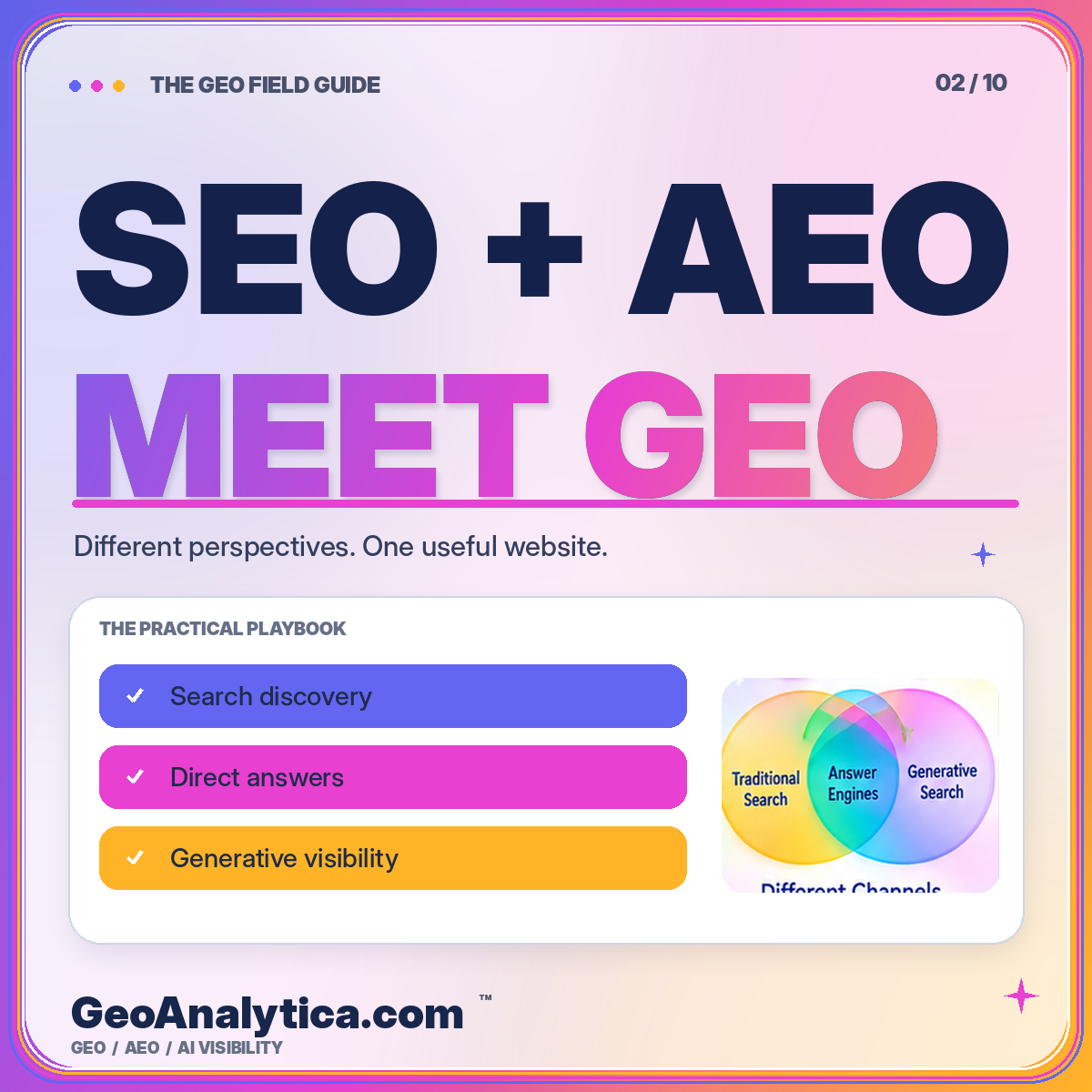
Compare SEO, AEO, GEO, and LLMO. Build one coordinated content strategy with clear responsibilities, useful pages, and meaningful measurement.
Build an AI search visibility program with a focused prompt set, clear source information, crawler awareness, and repeatable observations.
AI Visibility
Review relevant questions, inspect the sources shown in sampled answers, and connect findings to the pages your team can improve.
Source-first content
Build pages that can be safely quoted: definitions, constraints, and evidence.
Quote accuracy
Review whether statements preserve the facts and the conditions in the cited source.
Illustrative · sample data
See trendlines, assistant breakdowns, and the exact URLs getting cited.
Top cited pages
Query coverage
Compare the topics represented in your observed sample.
Scrolling banner: optimization themes
lightweight motion + reduced-motion supportContent Optimization
We format content for extraction: concise claims, proof nearby, and structured sections that answer the question cleanly.
Quick wins
Illustrative: a clear content structure
Answer blocks, constraints, and citations—organized for quick extraction.
Definition
What is GEO?
GEO connects useful public information with relevant audience questions and observed AI-generated answers.
Constraints
When it applies
Evidence block
Source
Primary docs
Timestamp
2026
Claim scope
Clear
CTA
Ready to plan a focused review of your content and AI visibility?
GEO FAQs
Understand the terms, the evidence, and what a focused GEO project can review.
Explore all FAQs ↗GEO is the work of improving how a brand’s public information can be discovered, interpreted, and referenced in AI-generated answers. A practical program combines useful content, technical access, consistent facts, and repeatable observation of relevant responses.
GEO places particular attention on representation in generated answers. SEO addresses broader search discovery. The work overlaps: useful pages, coherent navigation, accurate descriptions, and accessible public content remain important. Treat the labels as different priorities within a coordinated publishing plan.
No outcome is promised here. An audit can identify issues, an editor can improve a page, and an analyst can document observations. Inclusion in an external answer is a separate outcome that must be observed rather than assumed.
A mention records that the brand name appeared in an answer. A citation records a qualifying source reference to a page or domain. A separate accuracy review checks whether the response’s statement is supported by the cited page.
The dashboard panels are illustrative examples that explain reporting concepts. They are not connected to your website, do not run background monitoring, and do not present customer results. A real report requires collected and reviewed observations.
About
We connect content clarity with practical observation methods. Start with the information your audience needs, and make each next step specific enough to inspect.
What the work connects
Questions, evidence, pages, and observations.
How we review it
Documented samples and source accuracy checks.
Vibe check
Happy colors, serious measurement.
Contact
Share your public domain, audience, and priority questions to discuss a focused GEO review.
Fast first pass
Begin with a small set of important questions and pages.
Friendly + specific
Connect an agreed scope to practical, page-level next steps.
Send your public domain, audience, and a few priority questions. Keep passwords and sensitive information out of the message.
Your email application opens so you can review and send your message.
Google’s AI features guidance keeps established SEO fundamentals in view. Build useful, accessible information; treat external visibility as something to observe, not guarantee.