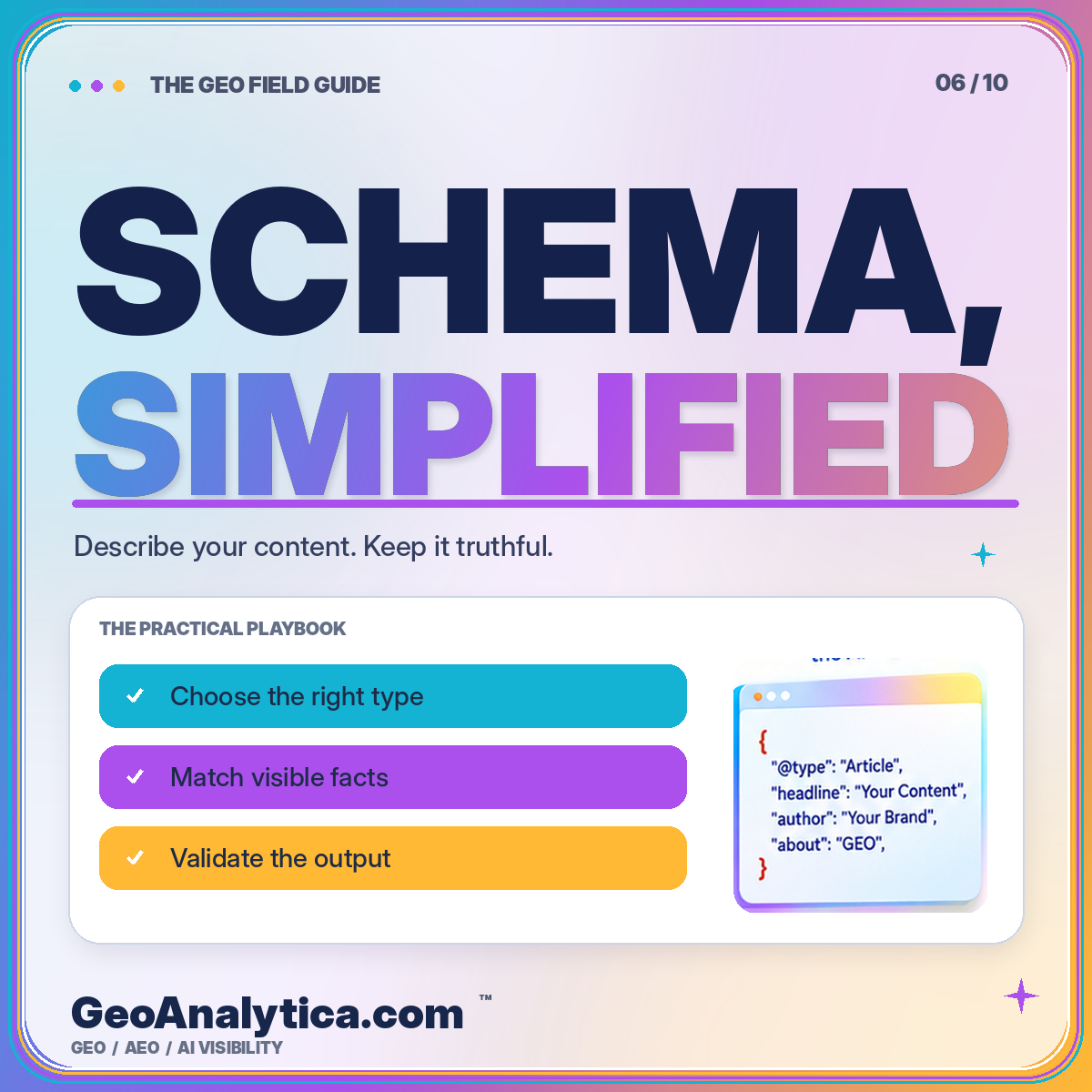
Structured data gives a page a machine-readable description of information that should already be visible to its readers. It can identify an article, a website, an organization, or a breadcrumb trail using a defined vocabulary. For a GEO project, the sensible starting point is accurate representation: describe the page you actually have, not the page you wish a search system would imagine. Markup cannot turn an unsupported claim into trustworthy evidence.
It is tempting to treat schema as a shortcut because it looks precise and technical. A block of JSON can appear more authoritative than ordinary prose. But precision of format is not the same as correctness of content. A useful implementation connects visible facts, stable identifiers, and appropriate schema types, then checks that the published version remains consistent.
Separate vocabulary, format, and search features
Schema.org provides a vocabulary for describing entities and relationships. JSON-LD is one format commonly used to express that information. A search feature is a separate product behavior that may use supported structured data under particular rules. These ideas belong together, but they are not interchangeable. A technically valid description does not establish that a particular presentation will appear.
Google’s introduction to structured data explains how markup helps describe page content and how supported features depend on relevant requirements. Use that documentation as a starting point for implementation. Do not turn it into a promise of rich results, a guaranteed AI citation, or a universal mechanism for making every assistant prefer your site.
Start with the content you can verify
Inventory the page’s visible facts before selecting properties. For an article, confirm the headline, description, author identity, publication date, and featured image. For a website, confirm the name and canonical domain. For an organization, include only established information you are authorized to publish. Empty or invented fields do not improve the quality of the description.
Do not add ratings, customer counts, credentials, addresses, or founding dates merely because they appear in an example implementation. A tutorial’s sample values are not your business facts. If a property is not supported by the page or reliable organization records, leave it out until the information can be verified and published appropriately.
Choose a small set of appropriate types
A content-focused website can often begin with WebSite and WebPage descriptions, BlogPosting for complete blog articles, and BreadcrumbList where the page has a visible navigation trail. An Organization entry can identify the publisher without inventing a physical location or legal structure. Keep the implementation understandable enough that the team can review what each type is doing.
Avoid attaching every available type to every page. A service overview is not automatically a product offer with a price. A collection of educational questions is not evidence that a particular search feature will be available. Start with accurate basics, then add detail only when the page has a genuine need and the relevant requirements are understood.
Use stable identifiers and coherent relationships
Give the principal entities consistent identifiers so repeated descriptions refer to the same website or publisher. A practical pattern is to base identifiers on the canonical domain with a meaningful fragment for the organization or site. Keep the pattern consistent across pages rather than generating a new organization identity for each article.
Connect the article to the page that presents it and the publisher that actually publishes it. Use the real image address and the canonical article address. Review the relationships as a simple map: website, page, article, publisher, image. If your team cannot explain the connections, simplify the graph before adding more properties.
Keep dates honest and internally consistent
A publication date should represent the editorial publication date used by the site. A modification date should describe a genuine substantive revision, not be refreshed automatically whenever the page is built. Keep visible dates and structured dates consistent. A reader should not encounter one date in the article header and a conflicting date in the machine-readable description.
When migrating a site, preserve reliable historical dates where they exist. If the history is uncertain, do not invent a precise update timeline to make the content appear established or newly revised. Document the uncertainty internally and choose an accurate representation. Date handling is part of editorial integrity, not an ornamental SEO field.
Match the markup to what readers can see
Compare each material property with the rendered page. Does the headline match? Is the author visible? Does the description accurately summarize the content? Does the image exist at the stated address? Are breadcrumb labels and destinations meaningful? This review catches mistakes that can survive a basic JSON syntax check.
Be especially careful with information that changes frequently. Product availability, offers, event times, and service details need a reliable source of truth. A manually maintained JSON block can become stale while the visible page changes. Our structured data approach emphasizes shared content fields and validation so the two representations do not drift apart.
Validate more than syntax
Use a JSON parser to catch malformed syntax, then review the schema vocabulary and the requirements of any specific feature you intend to support. These are different checks. A successful parse does not show that a property is appropriate, that its value is true, or that the page qualifies for a search presentation.
After publishing, inspect the delivered HTML rather than only the source file in your editor. Templates, content-management systems, and scripts can introduce duplicate or conflicting markup. Check the final page, its canonical link, image paths, and visible content together. Repeat this review after significant template changes instead of assuming a previously valid implementation remains correct.
A practical article implementation review
For an article page, confirm that the BlogPosting headline matches the H1, the description reflects the introduction, and the image is the actual featured artwork. Confirm that the author is the published author or responsible editorial organization. Use the canonical article address consistently. Omit unsupported metrics such as fabricated interaction counts or review scores.
Then inspect the surrounding graph. The WebPage should describe the page, the WebSite should identify the site, and the breadcrumb should reflect the visible hierarchy. Keep the model as simple as the content permits. A short, accurate graph is easier to maintain and audit than a large block copied from an unrelated business.
Avoid the most common schema shortcuts
Do not hide claims in markup that you would not publish visibly. Do not create fake experts, endorsements, or reviews. Do not assume that adding FAQ-related markup will automatically produce a special display. Do not publish internal identifiers that reveal sensitive information. Structured data is a public description and should receive the same factual review as the page itself.
Also avoid separating markup ownership completely from editorial ownership. A developer can ensure valid syntax, but may not know whether a claimed feature or author credential is accurate. Give the content owner a readable checklist and a way to review changes. Technical and factual validation work best as coordinated responsibilities.
A working example: check one article graph
Imagine an article whose visible byline names the site’s editorial organization, but whose JSON-LD still contains a fictitious person copied from a tutorial. The syntax may be valid while the description is wrong. Correct the author identity, use the actual featured image, and ensure the canonical page address is consistent throughout the graph.
Next, compare the headline and publication date against the page header. Check that the breadcrumb points to the real blog index rather than a nonexistent category. Remove a modification date that changes on every rebuild without an editorial revision. This review requires no elaborate scoring system. It requires a small set of visible facts and a careful comparison with the delivered structured description. Repeat the same check on another page type to catch template-specific assumptions.
Describe accurately, then maintain the description
Structured data is most useful when it is specific, truthful, and consistent with the page. Begin with appropriate types, stable identifiers, and verified facts. Validate the rendered output and revisit it when the content changes. Pair this work with technical SEO checks and clear content structure rather than treating markup as a substitute for either.