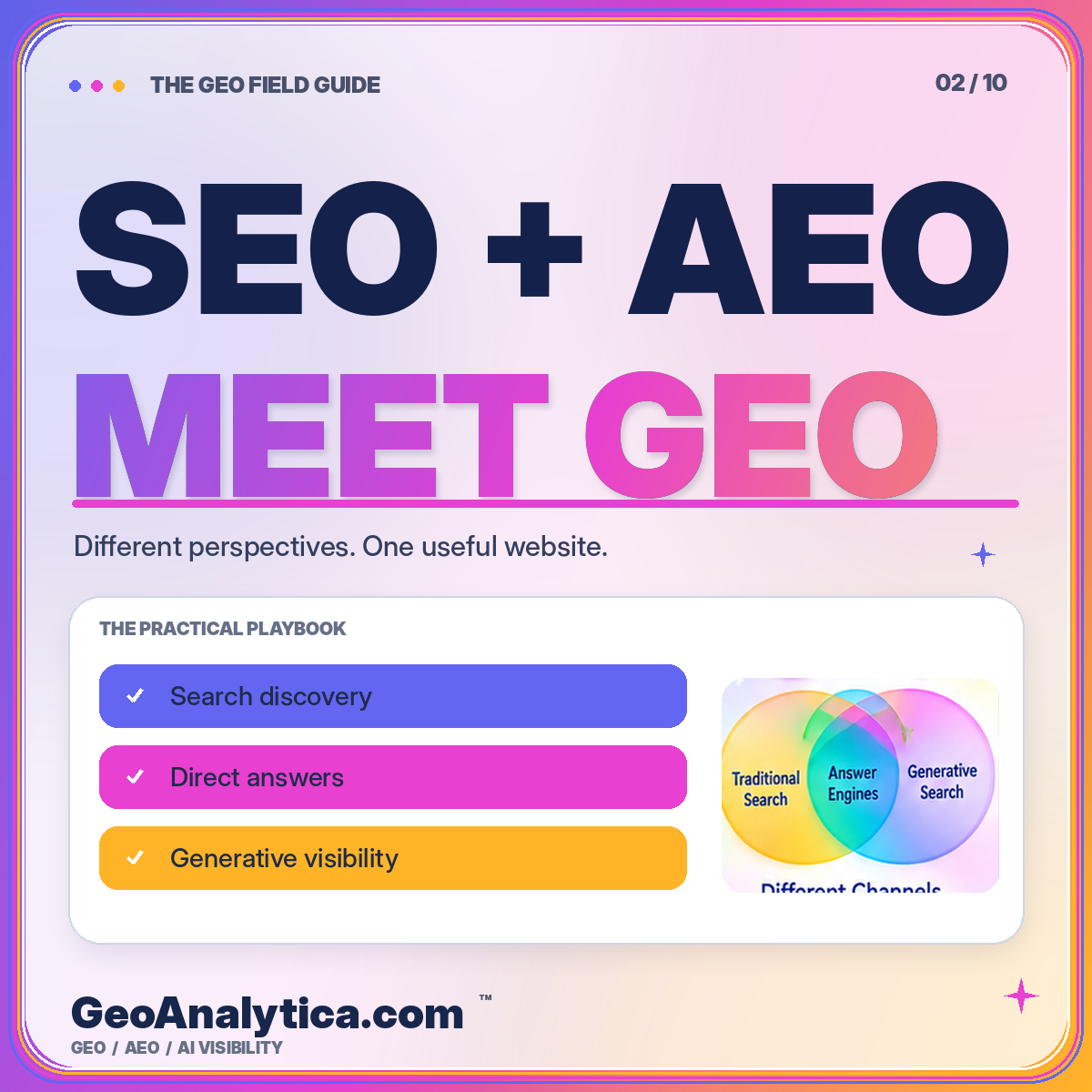
SEO, AEO, and GEO are often presented as competing strategies. A more useful approach is to treat them as overlapping ways of making information discoverable and useful. Search engine optimization addresses a website’s presence in search. Answer engine optimization focuses on answering questions clearly. Generative engine optimization examines how sources and brands appear in AI-generated responses. None of these labels removes the need for accurate content or a usable website.
The practical decision is not which acronym to choose. It is which problem your team needs to solve first. A page that cannot be reached has a different problem from a page that makes vague claims. A brand that appears in answers inaccurately needs a different review from one that is absent from a narrow sample. This comparison gives the terms operational meaning.
SEO: the broad discovery foundation
For planning purposes, treat SEO as the work of making your public pages discoverable, understandable, and relevant to searchers. That includes page purpose, internal navigation, technical delivery, descriptive metadata, and content that addresses actual needs. It is not simply a list of keywords added to a title. A technically accessible page still needs a reason for someone to read it.
Google’s guidance on AI features and websites states that established SEO practices remain relevant to AI Overviews and AI Mode, with no special additional optimization required. That statement concerns Google’s experiences; it should not be expanded into a universal claim about every assistant. It does, however, challenge the idea that a separate set of mysterious technical tags is essential.
AEO: make the answer clear without flattening it
We use AEO to describe content work that makes a question’s answer explicit and easy to understand. A direct introduction, a well-labeled comparison, or a procedure with clear prerequisites can help. The approach should preserve the qualifications that make an answer true. If a process differs by product version or customer type, state that difference beside the instruction.
Not every topic benefits from a tiny answer block. A complicated migration guide may need diagrams, examples, and a troubleshooting section. AEO should help a reader locate the relevant explanation, not compress a nuanced subject into an oversimplified sentence. The editorial test is whether the shorter explanation remains useful when someone reads it without the rest of the page.
GEO: study representation in generated responses
GEO adds a particular observation target: the answers produced in generative search experiences. Did the response mention the brand? Did it cite the domain? Which page was referenced? Was the cited information represented accurately? These questions require a defined test set and a careful record of the conditions under which each response was collected.
A GEO project can involve technical and editorial work, but the label itself does not establish a distinct ranking system or a guaranteed channel. Be cautious with reports that reduce every engine to one universal score. An aggregate can be useful for navigation, yet the underlying assistant, topic, and observation must remain available for inspection.
Where LLMO fits
Large language model optimization, or LLMO, is another term used around this work. In a website context, we use it narrowly for reducing ambiguity in public information: consistent entity names, clearly scoped statements, stable definitions, and coherent page relationships. That meaning is different from training, fine-tuning, or otherwise changing the model itself.
A marketing team publishing a product glossary has not updated an assistant’s internal parameters. Keeping those concepts separate avoids unrealistic expectations. Describe the deliverable plainly: a terminology guide, an entity map, a revised specification page, or a citation review. Our LLMO service overview uses this publishing-focused definition throughout.
Compare work by its intended outcome
Consider a hypothetical scheduling product. Its SEO work might clarify the page explaining team scheduling and improve how that page is linked from the product section. Its AEO work might add a direct answer about time-zone handling, followed by an example. Its GEO review might observe whether sampled assistants cite that explanation accurately when asked about distributed teams.
These are not three unrelated content projects. They are different views of one source. Keep one owner for the product facts and one current page for each distinct purpose. Coordinate the work in a shared backlog so that three teams do not publish competing definitions, duplicate comparison pages, and separate reports that cannot be reconciled.
Choose metrics that match the question
For search discovery, decide which page and query groups matter and examine the relevant available reports. For answer quality, inspect whether the page provides a direct, accurate explanation with the necessary context. For generative visibility, measure observations from a defined prompt set. Each measure should tell you something specific enough to support a decision.
Do not substitute one outcome for another. A citation does not establish that someone visited, and a visit does not establish that the visitor became a customer. A branded answer does not demonstrate unbranded discovery. Keep these categories separate before building summary charts. The AI visibility analytics framework explains how to label the layers without overstating the evidence.
Prioritize the bottleneck rather than the label
When resources are limited, begin with the obstacle closest to the audience’s immediate need. If essential documentation is inaccessible, review its delivery. If the product explanation contradicts itself, resolve the factual disagreement. If the content is sound but nobody knows which questions to monitor, build the prompt sample. The name assigned to the project is secondary.
Use a small decision record for each task: the audience problem, the proposed change, the supporting evidence, the owner, and the validation method. This record keeps a fashionable acronym from becoming the justification for every request. It also gives the next reviewer enough context to judge whether the work actually addressed the original issue.
How to evaluate an agency or service proposal
Ask what the provider will deliver and how the deliverable can be inspected. An audit should include page-level findings, not only a score. Monitoring should identify the prompts, modes, and observation dates. Content work should define who verifies claims and approves revisions. Reports should distinguish sample observations from platform-wide audience data.
Look closely at guarantees and unexplained proprietary metrics. A promise of certain inclusion across all assistants is not a substitute for a documented process. Ask how missing observations are handled, how results are reproduced, and what counts as a citation. A clear, modest methodology is more useful than an impressive chart whose units nobody can define.
Create one coordinated publishing workflow
A practical shared workflow starts with the audience’s question, identifies the best existing source, checks factual support, and reviews technical delivery. The team then publishes a scoped improvement and observes the relevant outcome. Product specialists own the facts, editors own clarity, developers own implementation, and analysts own the interpretation of the available evidence.
Set a regular review cadence without assuming every week requires new pages. Sometimes the correct decision is to merge two overlapping guides, remove an outdated claim, or leave a strong page alone. Record those decisions alongside published changes. A coordinated strategy should reduce duplication and confusion, not multiply the volume of work for its own sake.
A working example: one page, three responsibilities
Consider a hypothetical guide to exporting customer data from a product. The technical owner checks that the page loads at its maintained address and is linked from the documentation hub. The editor adds a direct explanation of eligible export formats and a procedure with prerequisites. The analyst observes a defined set of export questions and records whether the guide is cited accurately.
Calling these tasks SEO, AEO, and GEO may help allocate responsibility, but it does not justify three different export guides. A shared source of truth avoids contradictory formats or missing limitations. During review, the team checks delivery, comprehension, and observed representation separately. This provides a clearer account of progress than reporting that the page received a generic optimization score, especially when some work is complete and other outcomes remain uncertain.
The useful distinction is focus, not rivalry
SEO, AEO, GEO, and LLMO can describe different priorities inside a single, coherent content program. Use the terms to clarify responsibilities and measurement, not to manufacture boundaries between teams. Begin with a concrete audience problem, define what evidence would indicate progress, and select the smallest reliable intervention. Our GEO services overview connects these priorities into one practical planning process.