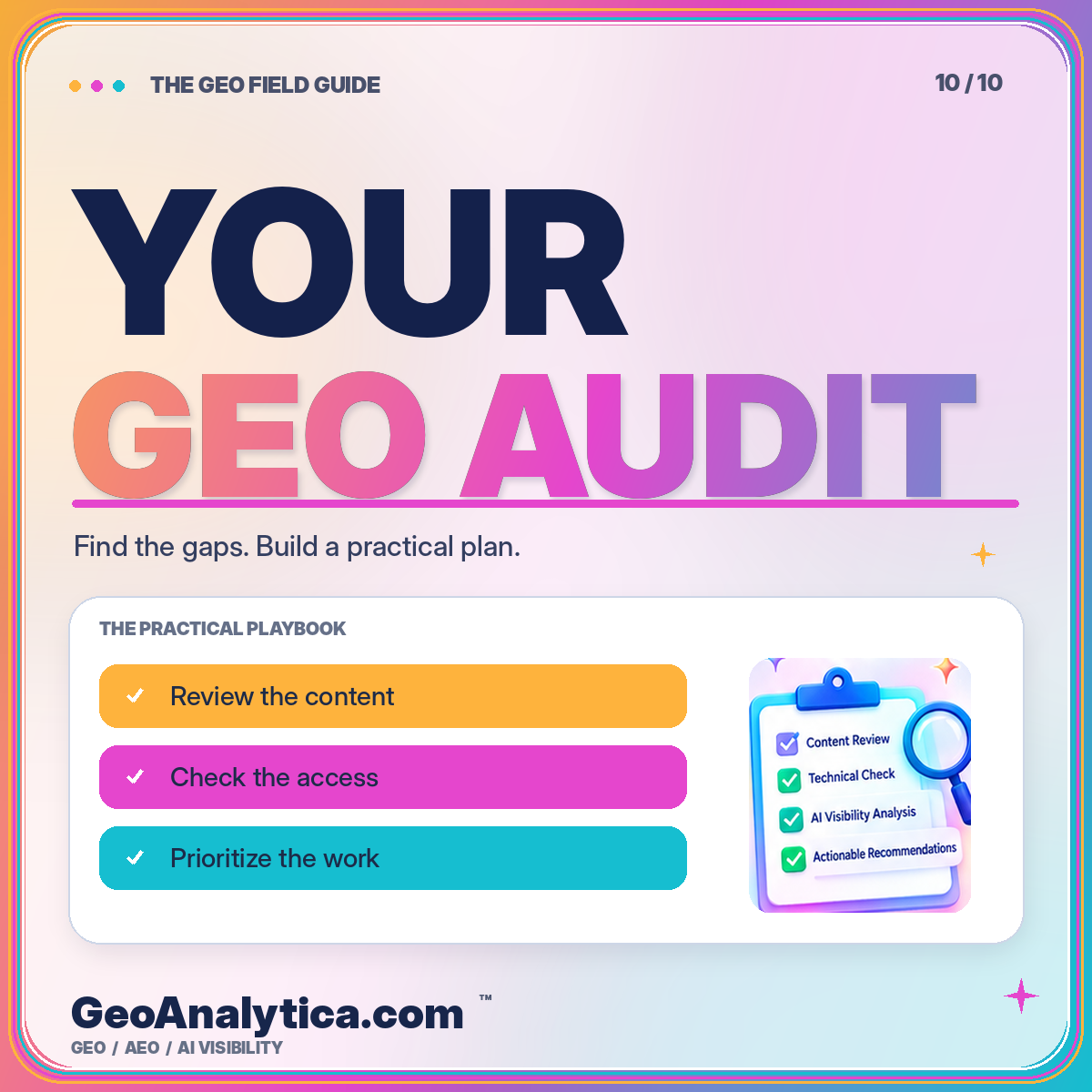
GEO Audit Checklist: From Content Review to Action Plan
Run a focused GEO audit covering audience questions, page evidence, technical access, citations, and a prioritized implementation backlog.
6 min readRead the guide
GEO audit
Build a useful picture of where your website stands. A focused audit connects each finding to a real page, an accountable owner, and a practical validation step.
01 / GEO Audit
Identify the domain, audience, language, market, priority products, and topic groups. Decide whether the review is intended to inform a content refresh, technical cleanup, or monitoring pilot. Record limits such as unavailable analytics or restricted documentation.
A first conversation can begin with your public domain and three important questions. Do not send passwords, private customer information, or confidential plans. Any project scope, timeline, and fee should be agreed separately.
02 / GEO Audit
The source review examines purpose, evidence, clarity, page relationships, and public delivery. The observation review documents a defined set of prompts, assistant modes, dates, responses, and citations. Keep implementation facts separate from external observations.
Each material recommendation should have a traceable basis. A product claim may need specialist verification, a broken link needs a delivery fix, and an ambiguous observation may need another test. Generic advice without a page or example is not enough.
03 / GEO Audit
The proposed audit outputs are a page inventory, topic map, evidence-gap register, technical findings, observation notes, and a prioritized backlog. Define acceptance checks so the team knows how to confirm each implementation.
Judge priorities by the affected audience need, confidence in the finding, and expected effort. A scoped audit creates a basis for decisions. It does not promise a fixed ranking, a guaranteed citation, or an immediate change in business outcomes.
GEO Field Notes
Run a focused GEO audit covering audience questions, page evidence, technical access, citations, and a prioritized implementation backlog.
Understand generative engine optimization, the role of evidence and accessible content, and a practical workflow for measuring AI visibility.

Review crawler access, delivered HTML, canonical URLs, internal links, and mobile usability before expanding your GEO content program.
Bright ideas. Practical next steps.
Share your public domain, audience, and priority questions. Start with a scope built around the information your readers actually need.