Generative engine optimization, usually shortened to GEO, is the work of making a brand’s useful information easier to discover, understand, and accurately reference in AI-generated answers. It combines content strategy, technical accessibility, clear entity information, and observation of real responses. The goal is not to insert a brand into every conversation. It is to make the right source available when someone asks a question that the organization can genuinely help answer.
That distinction matters. A company can publish hundreds of pages and still leave its most important customer questions unanswered. Another can explain its product precisely but make those explanations difficult to reach. A useful GEO program examines both problems. This guide introduces a practical way to connect the questions people ask with the evidence your website actually provides.
What the term GEO does—and does not—describe
The research paper GEO: Generative Engine Optimization studies content visibility within generative-engine responses. Its experimental findings should not be treated as a guaranteed improvement for a commercial website, a permanent ranking formula, or proof of additional revenue. We use GEO here as a working label for an evidence-led publishing and measurement process, not a proprietary score.
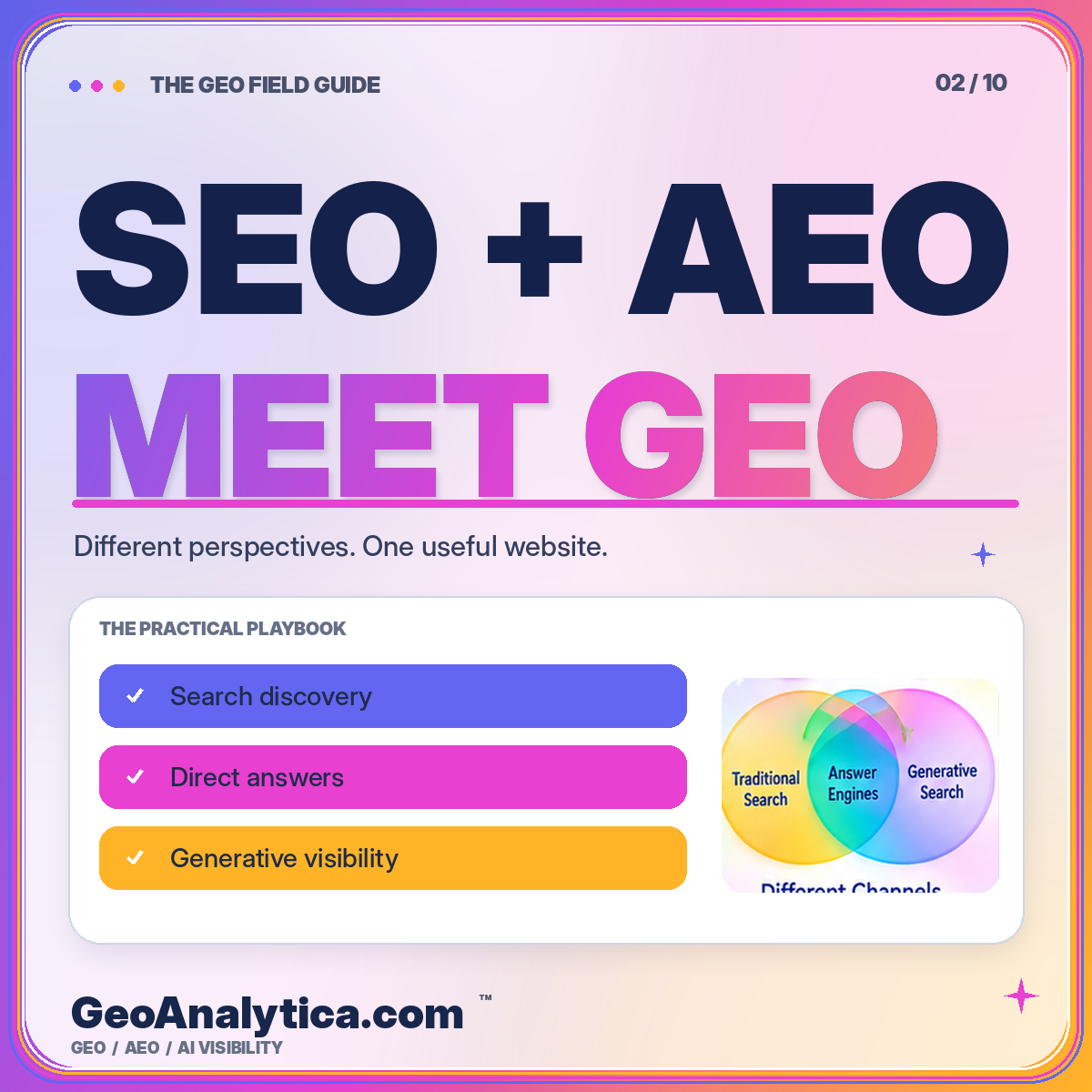
A related term, answer engine optimization, emphasizes direct answers. Large language model optimization often emphasizes how clearly a model can interpret entities and claims. These labels overlap. Define them with your team before creating separate budgets or reports. A useful definition describes the work, its intended outcome, and the limits of what your measurement can demonstrate.
Start with a real audience question
Begin with questions that a prospect, customer, researcher, or partner would reasonably ask. A software company might investigate compatibility, migration effort, data export, and purchasing criteria. A specialist service might explain scope, preparation, timelines, and alternatives. Organize questions by the decision they support rather than by how many variations of a keyword can fit into a spreadsheet.
Separate branded questions from unbranded questions. “Does this product support a particular integration?” checks whether your existing identity is represented accurately. “How should a small team evaluate integration tools?” examines discovery before a buyer knows your name. Both can matter, but combining them can hide a serious weakness. Keep informational, comparison, and implementation questions in distinct groups as well.
Map questions to evidence, not just pages
For every question, identify the page that should answer it and the evidence that makes the answer credible. Evidence may be a product specification, a documented process, an original calculation, a methodology, or a clearly scoped example. Do not assume a page is adequate because its title contains the keyword. Read it as someone deciding whether to trust the answer.
Record missing evidence separately from missing prose. A writer can improve a confusing explanation, but cannot responsibly invent a capability, customer outcome, or test result. Assign those gaps to the person who can verify the underlying information. This simple distinction keeps a GEO backlog from becoming an exercise in manufacturing authoritative-sounding paragraphs.
Make the information easier to interpret
Give each important page a clear purpose. Introduce the subject directly, define unfamiliar terms, and use descriptive headings to make the structure visible. Keep conditions close to the statements they limit. “Available on the enterprise plan” should appear beside the feature, not in a disconnected footnote several screens away. A short answer is useful only when it remains accurate outside the surrounding sales pitch.
Use comparisons where the reader is choosing, procedures where the reader is acting, and definitions where the reader is learning. Avoid forcing every page into the same question-and-answer pattern. Our content optimization approach treats structure as a way to improve comprehension rather than a trick for persuading a model to select a source.
Check the path from public page to usable source
A content review should include a basic accessibility check. Can a visitor reach the page through ordinary links? Does the main answer appear without signing in? Does the page work on a phone? Is critical information contained only in an image? These checks help distinguish a writing problem from a delivery problem before anyone starts rewriting a page that is already clear.
Document the canonical address you intend to maintain. Product renames, duplicated guides, and old campaign pages can create competing explanations of the same subject. Build a deliberate plan for which page should remain current. Coordinate technical changes with whoever manages hosting and indexing; do not remove access controls from private material in the name of greater visibility.
Observe answers without overinterpreting them
Create a modest, repeatable set of prompts and save the conditions of each observation. Record the assistant, product mode, date, language, exact prompt, and any visible citations. Note whether your brand was mentioned, whether your domain was linked, and whether the linked page actually supported the answer. These are separate questions, not interchangeable indicators of success.
Repeat observations rather than celebrating a single favorable screenshot. When results change, inspect the underlying response before attributing the movement to an edit. A prompt revision, different mode, or changed citation display can alter the comparison. The prompt testing kit provides a simple record structure for keeping those conditions visible.
A focused first-month GEO plan
In the first week, choose one commercially relevant topic and document the questions around it. Review a small set of existing pages and identify the strongest source for each answer. During the second week, resolve obvious factual gaps with the appropriate owner. Rewrite unclear passages only after the evidence is available, and preserve a dated record of what changed.
Use the next part of the month to publish a coherent set of improvements, check navigation and page delivery, and collect repeated observations. Finish with a review that separates completed work from observed effects. “Five pages now explain eligibility clearly” is a deliverable. “The domain appeared in six sampled answers” is an observation. Neither statement alone proves a revenue outcome.
Decide what success should mean
Choose success criteria before collecting results. For an early project, the first objective might be accurate representation of a product’s limitations. For another, it may be discovery in a specific comparison topic. A third team may care primarily about qualified visits to implementation documentation. Select a manageable set of outcomes that matches the purpose of the pages being improved.
Include operational measures as well. Can the team identify the owner of an important claim? Can a reader find the current specification? Does the report preserve the denominator behind each percentage? These questions are less glamorous than a visibility score, but they expose whether the program is building reliable publishing habits or merely collecting colorful charts.
Common mistakes to avoid
Do not promise inclusion, manufacture quotations, or describe every brand mention as a recommendation. Avoid publishing near-identical pages solely to target differently worded prompts. Resist the temptation to put hidden instructions inside public pages telling an AI assistant what to say. A strong source earns its usefulness through relevant information that a human reader can inspect.
Also avoid treating GEO as a replacement for the rest of your website. Navigation, customer support, product accuracy, accessibility, and conventional search remain part of the same publishing system. The best starting point is usually a specific question your current content answers poorly, not an expensive attempt to redesign everything at once.
A working example: a missing compatibility answer
Imagine a small software company whose homepage says its product integrates with common tools, while the documentation lists only three supported connections. An audience question asks whether a particular fourth tool is supported. The first task is not to produce a new comparison article. It is to ask the product owner for an accurate answer and publish the relevant limitation on the maintained integration page.
The team can then link that page from the product overview and test a clearly labeled set of compatibility questions. If the revised page is not cited, the factual improvement still benefits readers. If an answer cites it but overstates support, the saved response identifies a representation problem worth reviewing. This example keeps the work grounded in a real informational need and separates the corrected source from the external behavior being observed.
Build a useful source, then learn from the evidence
GEO becomes manageable when you connect audience questions, verified information, accessible pages, and repeatable observations. Start small enough that your team can explain every change. Keep claims proportionate to evidence, and judge visibility alongside accuracy and meaningful visitor behavior. Explore our generative engine optimization framework to turn that approach into a practical scope of work.